
In Southern California, the attic sits at the intersection of climate, building practice, and utility pricing. It is rarely living space, yet it often dictates how hard an air conditioner or heat pump must work to keep the rooms below stable. In a region with long cooling seasons, frequent heat waves, and some of the highest residential electricity prices in the United States, small thermal weaknesses become expensive patterns.
The pricing backdrop is not subtle. The U.S. Energy Information Administration (EIA) reports an average residential electricity price in California of 32.04 cents/kWh (September 2025). That figure is a statewide average, not a Southern California bill, yet it frames why attic insulation attracts scrutiny: wasted kilowatt-hours in a high-rate market produce high-cost discomfort.
Table of Contents
Attic insulation affects energy efficiency through three main channels:
- It slows heat transfer through the ceiling plane.
- It changes attic air temperatures, which alters HVAC duct losses when ducts run overhead.
- It interacts with air leakage, since insulation without air sealing often performs below its label rating.
Each channel behaves differently across coastal, valley, desert, and mountain subclimates that sit inside “Southern California.”
Heat Flow in a Region of Microclimates
Southern California gets described as “mild,” yet its buildings experience sharp thermal stress. Coastal nights cool quickly; inland valleys can swing from cool mornings to intense afternoon heat; deserts sustain high outdoor temperatures into the evening. That range shifts the value proposition of attic insulation from “winter comfort upgrade” to “year-round load management.”
The U.S. Department of Energy (DOE) puts a number on the stakes, based on national averages: “On average, you can save up to 20% on your home’s heating and cooling costs or up to 10% on its total energy costs” by adding insulation in key areas and reducing air leaks. This is not a Southern California-specific field measurement; it is a general estimate. Still, it identifies the ceiling/attic as one of the highest-leverage parts of the enclosure.
EPA’s ENERGY STAR program provides a second widely cited estimate tied to attic work bundled with air sealing: “EPA estimates that homeowners can save an average of 15% on heating and cooling costs (or an average of 11% on total energy costs) by air sealing their homes and adding insulation in attics…” (ENERGY STAR: Rule Your Attic)
Those percentages are averages across “typical” U.S. homes under model assumptions. Southern California results can land above or below them, depending on duct placement, existing insulation, air leakage, thermostat behavior, and the local climate zone.
R-Value: The Metric That Shapes Attic Strategy
Insulation choices get marketed through material types—fiberglass batts, blown cellulose, spray foam—yet the performance conversation still starts with R-value. DOE defines it plainly: “An insulating material’s resistance to conductive heat flow is measured or rated in terms of its thermal resistance or R-value — the higher the R-value, the greater the insulating effectiveness.”
The question in Southern California is rarely “insulate or not.” It is “how much,” and “where,” given roof geometry, mechanical layout, and code context.
ENERGY STAR publishes recommended retrofit ranges by climate zone. For attic upgrades, it lists target levels such as R49 for Zones 2 and 3, and R60 for Zones 4A and 4B. Many Southern California locations fall into warm-dry or mixed-dry categories, yet California’s own climate zoning is more granular than the national map. The California Energy Commission (CEC) notes that it established 16 building climate zones, and provides a tool for matching an address to the correct zone.
For residents, that split matters. A coastal home that rarely sees extreme cold can still rack up cooling costs if the attic becomes a hot reservoir above bedrooms. A high-desert home faces sustained cooling demand plus colder winter nights. A one-size “R-value rule” misses those patterns.
Ductwork in the Attic: Where Insulation Meets Mechanical Reality
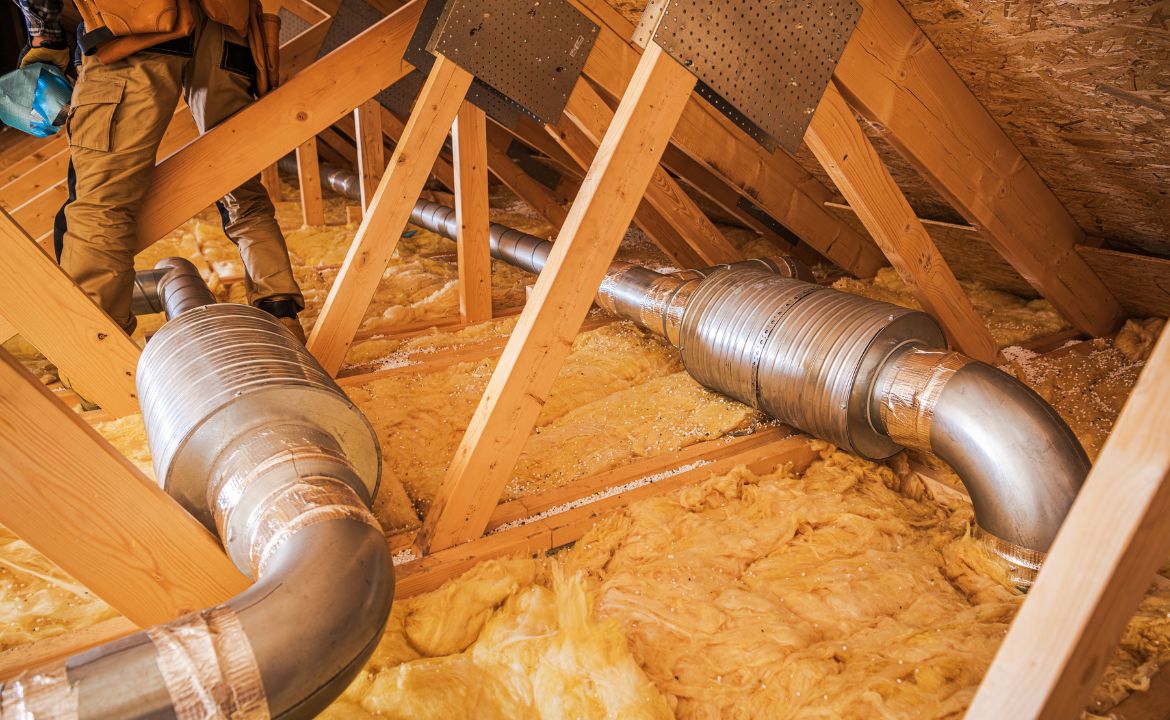
A large share of Southern California houses place HVAC ducts in the attic. That design choice turns attic temperature into a direct energy penalty: cold supply air moving through a very hot attic gains heat; warm supply air in winter loses it to cold attic air. The insulation on the ducts helps, yet the attic environment still pushes losses, and leakage makes the losses sharper, which leads many homeowners to the proverbial Google search for “Insulation contractor Los Angeles“.
The National Renewable Energy Laboratory (NREL) explored this dynamic in hot-dry climates by comparing vented and unvented attic configurations. One result reads like a warning label for leaky duct systems: “cooling energy savings is predicted to be about 8% when duct leakage is 10%.” The same report adds that unvented attics have “a small effect” when duct leakage is small, signaling a theme that contractors often state less formally: the attic strategy does not rescue a leaky distribution system.
This matters in Southern California for two reasons:
- Duct leakage can be hard to detect from living space symptoms alone.
- Attic duct repairs are physically unpleasant work, so they are frequently deferred until a system replacement.
A practical investigative read of many “high bill” stories is that the attic hosts two issues at once: insufficient insulation on the ceiling plane, plus ducts losing conditioned air into the attic volume.
Air Sealing: Insulation’s Quiet Partner
Insulation slows conduction. Air sealing limits convective exchange and uncontrolled infiltration. The two interact. Even high R-value insulation can underperform if attic bypasses allow hot attic air to mix with the house air or let cooled indoor air spill upward.
ENERGY STAR’s guidance ties savings to combined measures rather than insulation alone: “air sealing their homes and adding insulation in attics” is treated as a coupled project, not competing upgrades. (ENERGY STAR: Rule Your Attic) The wording is careful: air sealing plus insulation is where EPA’s modeled savings come from.
In Southern California, common attic leakage paths include:
- Recessed light fixtures not rated for insulation contact
- Plumbing penetrations under bathrooms
- Open wall top plates at partition walls
- Attic hatches that lack gasketed seals
A homeowner can treat attic insulation as “adding depth,” yet the energy outcome often depends on whether these leakage paths get sealed with compatible materials before insulation gets topped off.
Vented vs. Unvented Attics: A Choice With Conditions
The vented attic remains the standard in much of Southern California: soffit vents plus ridge vents, insulation on the attic floor, ducts and air handler often sitting above the insulation layer. Unvented attics relocate insulation to the roof deck, bringing the attic volume closer to the indoor thermal boundary.
NREL’s findings show why this choice resists simple slogans. With leaky ducts, a semi-conditioned attic can reduce cooling waste. With tight ducts, the gap narrows. A neutral reading is that unvented attics can be an energy tool, yet the tool is not universal; it is linked to duct location and leakage.
Southern California homeowners evaluating this decision tend to land in two buckets:
- Ceiling-plane upgrades (common retrofit path): air seal the ceiling, add blown insulation to reach a target R-value, then address duct sealing and duct insulation.
- Roofline upgrades (more invasive): convert to an unvented assembly with insulation at the roof deck, often paired with HVAC redesign or relocation.
The first bucket fits most existing homes. The second can make sense during major roof replacement or deep energy retrofits.
Material Choices: Blown Fiberglass, Cellulose, Spray Foam
Material selection changes installation details, not the physics goal: reduce heat transfer, limit air movement, control moisture risk. The best material depends on attic geometry, budget, and whether the project includes air sealing.
A decision framework that stays grounded in outcomes:
- Blown fiberglass: common for “add depth” projects; performance depends heavily on uniform coverage and wind washing control at eaves.
- Blown cellulose: higher density can reduce air movement within the insulation layer; moisture management and clearance to heat sources must follow manufacturer specs.
- Spray foam at roof deck: often used in unvented attic conversions; it can deliver air sealing plus insulation in one step, yet it changes drying potential and requires attention to fire safety and code requirements.
Even without a code deep dive, the placement principle matters. The 2022 California Energy Code text describes where insulation must be installed depending on attic type: “For vented attics, the mandatory insulation shall be installed at the ceiling level; for unvented attics, the mandatory insulation shall be placed…” The line reflects a key idea: insulation location defines what is inside the thermal boundary.
Cost Payback Under High Electricity Prices
When electricity runs at California’s reported average of 32.04 cents/kWh, the economics of reducing cooling load shift. A modest reduction in AC runtime can produce a noticeable bill change during peak summer months. That effect can feel larger than in lower-rate states, even when the physical energy savings are similar.
Tax credits and rebates can compress payback timelines, yet they change frequently, so the safest approach is to cite only current program language from primary sources.
For federal tax incentives, the IRS describes the Energy Efficient Home Improvement Credit in plain terms: “A 30% credit, up to a maximum of $1,200, may be allowed for: Insulation material or air sealing material or systems.” The IRS credit page adds timing boundaries for claims that homeowners must check against the current year: it states the credit can be claimed “through December 31, 2025.”
For utility and state pathways, income-qualified households in California can access no-cost weatherization support through CPUC’s Energy Savings Assistance program, which lists “Attic insulation” among services provided. This matters in Southern California where renters and lower-income homeowners face both heat exposure and high energy burdens.
A Field Checklist for Southern California Attic Upgrades
Homeowners aiming for measurable gains can treat the attic as an inspection site, not a storage closet, not a storage closet. A practical checklist:
- Map the climate zone
- Use the California Energy Commission’s climate zone tool to match the address to a building climate zone.
- Measure what is already there
- Identify insulation type, depth, and coverage gaps near eaves and around obstructions.
- Air seal before adding insulation
- Seal penetrations at top plates, plumbing stacks, and ceiling fixtures with materials rated for the application.
- Address attic access
- Add gasketed seals and insulation to the hatch or pull-down stair cover to reduce bypass losses.
- Evaluate ducts
- Look for disconnected joints, crushed flex duct runs, and aging duct insulation; pair attic insulation work with duct sealing when ducts run overhead.
- Avoid blocking ventilation paths in vented attics
- Keep soffit vents clear with baffles; prevent insulation from choking intake airflow.
- Document for incentives
- Save invoices, product documentation, and manufacturer certification statements where required for tax credit claims.
A final operational note: attic projects fail quietly. The attic looks “fluffier,” yet the bill does not move much. That pattern usually traces back to uneven coverage, skipped air sealing, or duct losses that dominate the load.
Final Considerations
Attic insulation in Southern California is not a cosmetic upgrade; it is a system intervention tied to climate zones, mechanical layout, and electricity pricing. National sources put credible savings bands on combined air sealing and insulation work—DOE cites “up to 20%” heating and cooling savings, and ENERGY STAR cites a 15% heating and cooling savings estimate for bundled measures. Local outcomes hinge on attic duct conditions, with NREL modeling showing that duct leakage levels can swing cooling savings meaningfully.
In a state where the average residential electricity price has been reported at 32.04 cents/kWh, wasted cooling and heating energy carries a larger financial penalty than most homeowners expect. A disciplined attic plan—climate-zone check, air sealing, uniform R-value target, duct evaluation, and documentation for credits—tends to outperform quick “add some insulation” jobs, not through marketing promises, through physics and billing math that show up month after month.