

Key Takeaways
- Behavioral assessments offer a comprehensive way to evaluate and develop future leaders by focusing on personality, cognitive skills, and emotional intelligence.
- These tools provide objective, science-backed insights into leadership potential, beyond just resumes or interviews.
- Utilizing assessments helps organizations create more tailored leadership development plans and keep pace with the rapidly shifting business environment.
- The future of leadership evaluation lies in integrating technology with behavioral science, opening up new possibilities for AI-driven insights.
Table of Contents
Understanding Behavioral Assessments
Organizations are increasingly turning to behavioral assessments to discover and nurture effective leaders. These tools are designed to look far deeper than surface-level qualifications. A core advantage of behavioral assessment is its focus on how individuals act, think, and interact within diverse workplace scenarios, rather than relying solely on traditional metrics like experience or education. When used as part of a leadership development assessment, these methods deliver a much richer picture of a candidate’s leadership potential.
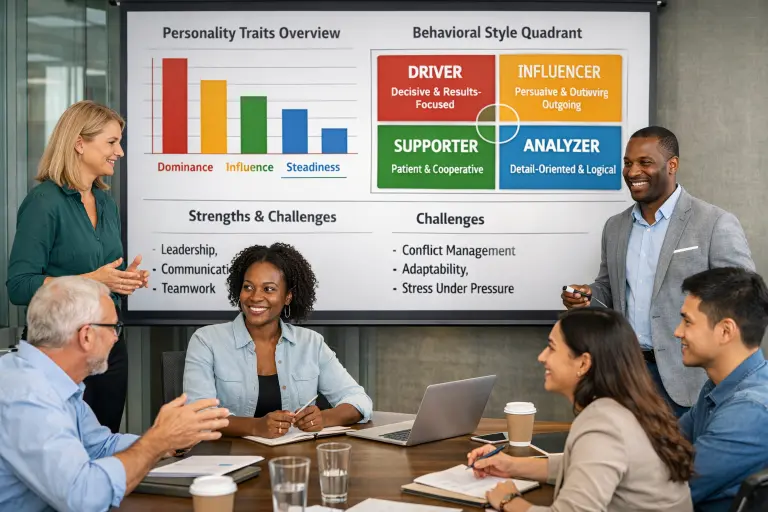
Behavioral assessments go beyond resumes by analyzing personality traits and cognitive abilities in detail. Tools like personality assessments provide structured insights that help organizations identify potential leaders more accurately. By integrating data from various situational responses, organizations can build a holistic profile of their future leaders, revealing how they behave under stress, collaborate with teams, and make critical decisions — qualities that are increasingly vital in today’s dynamic workplace landscape.
Additionally, behavioral assessments often rely on well-validated psychometric instruments, such as the Big Five personality traits model, situational judgment tests, and emotional intelligence measures. These methodologies are robust tools that consistently yield significant insights into leader effectiveness and their adaptability in complex, unpredictable environments. Beyond individual analysis, organizations can apply aggregated assessment data to spot leadership trends across entire departments, enabling more strategic workforce planning and targeted interventions. Integrating such assessments at multiple levels of leadership pipelines also fosters a culture of continuous improvement and self-awareness, which is crucial for sustaining organizational health and success. Companies gain deeper clarity about the collective strengths and development areas that can inform future training, mentorship, or succession planning initiatives.
The Science Behind Behavioral Assessments
Research consistently supports the link between specific behavioral patterns and effective leadership. For example, a recent study published on arXiv highlights that leaders who foster more open dialogue and questioning tend to drive their teams to better outcomes. This scientific backing reinforces the idea that leadership is not just about giving orders; rather, it is about how a leader interacts, adapts, and responds to challenges.
Furthermore, leading publications such as Harvard Business Review emphasize that robust leadership assessments grounded in behavioral science can help companies avoid the pitfall of promoting based merely on technical skills. Instead, organizations are able to identify people whose behavioral traits align with organizational needs and team culture.
Benefits of Implementing Behavioral Assessments
- Objective Evaluation: Behavioral assessments are grounded in scientific methodologies that reduce unconscious bias and improve fairness. They offer a standardized way to evaluate all candidates, eliminating the influence of personal preferences that may come into play during interviews.
- Predictive Accuracy: By linking observed behaviors to future performance data, these assessments help organizations identify individuals who are likely to thrive in leadership situations. This predictive power reduces turnover and boosts the effectiveness of promotion decisions.
- Personalized Development: With clear data on behavioral strengths and weaknesses, leaders receive actionable feedback and can pursue growth opportunities tailored to their specific needs, resulting in more meaningful and sustainable professional development.
Many organizations are updating HR strategies to include behavioral data in leadership planning. This shift toward strategic leadership ensures that talent development aligns with long-term business goals. The shift towards science-backed assessments is supplementing HR efforts globally.
Employees also tend to feel more valued and understood when assessments are used, fostering higher engagement and morale across teams. By communicating the intent and benefits of these assessments transparently, organizations encourage self-reflection and buy-in, leading to a more positive perception of the leadership development process. The ripple effects can be seen in stronger talent pipelines and more robust internal mobility.
Real-World Applications
In practice, leading companies now incorporate behavioral assessments into every stage of their talent strategy. For instance, platforms such as TraitKey offer innovative tools that help businesses evaluate how well an individual’s behavior meshes with company values, identify areas for enhanced team cohesion, and visualize how their people interact using dynamic dashboards.
The integration of these assessments has proven especially valuable for organizations undergoing change management, mergers, or rapid growth. Behavioral data aids in assembling leadership teams that complement one another, drives employee engagement, and ensures new leaders embody the company’s cultural DNA.
One of the most significant advantages of adopting behavioral assessment tools in real-world scenarios is the ability to track progress over time. This longitudinal approach allows organizations to measure the impact of their leadership development initiatives and refine programs to address emerging skill gaps. As workplaces evolve, organizations leverage behavioral data not only for selection but also for measuring organizational climate, enhancing diversity and inclusion efforts, and ensuring that their leadership development strategies adapt to changing business priorities.
Challenges and Considerations
Despite their advantages, behavioral assessments are not without pitfalls. Organizations must select validated tools, those tested to guarantee accuracy, reliability, and fairness. Improperly designed assessments can inadvertently introduce new biases or overlook vital qualities unique to a company’s context.
To be most effective, behavioral tools should not stand alone but be paired with traditional interviews, skills assessments, and ongoing performance reviews. A multi-method approach ensures a well-rounded view of each candidate and increases confidence in organizational decision-making.
Future Trends in Leadership Assessment
Looking forward, the intersection of technology and behavioral science is set to revolutionize leadership development. Artificial intelligence and machine learning are making it possible to analyze vast amounts of behavioral data quickly and spot trends not easily discerned by humans. New research, as seen in the paper “Beyond Self-Reports: Multi-Observer Agents for Personality Assessment in Large Language Models“, suggests the power of AI-driven tools to create even more nuanced, real-time evaluations.
As these innovations continue to evolve, organizations of all sizes will have more comprehensive insight into what makes effective leaders, allowing them to remain agile and competitive in a fast-moving business landscape.
We may soon see the widespread adoption of continuous, real-time behavioral assessment platforms that offer instant feedback loops for both current and aspiring leaders. These solutions could enable organizations to tailor development journeys more individually, while also rapidly responding to shifts in leadership trends or workplace challenges. The dynamic blending of digital analytics with behavioral science will push organizations to rethink not only how they assess, but ultimately how they empower leadership at every level.
Conclusion
Behavioral assessments are fundamentally changing how companies identify and develop their leaders. By focusing on actions and attitudes rather than only experience or technical skills, organizations can build dynamic leadership teams ready for the demands of tomorrow. Choosing the right assessment tools and using them as part of a broader evaluation framework will ensure businesses find and nurture the leaders who will drive their vision forward.
In summary, as the business world grows more complex, companies cannot afford to rely solely on intuition or old models of leadership selection. Robust behavioral assessment tools, thoughtfully implemented, offer a path to increased organizational resilience, innovation, and sustainable success. By investing in these state-of-the-art approaches now, companies position themselves to unlock leadership potential that not only meets today’s needs but also anticipates tomorrow’s opportunities.