

Table of Contents
The Foundation of Sustainable Expansion
In today’s competitive business world, achieving true growth is more than just increasing sales. It means building a path to lasting success. Research shows that only about 25% of companies manage to grow consistently over time. Yet, these top performers generate significantly higher returns for their shareholders. This highlights the crucial role of a well-defined business growth strategy.
For service-based businesses, navigating this landscape requires a clear understanding of effective growth strategies. It also needs strategic systems to support scaling efforts.
We will explore the core strategies that drive expansion and sustainability. We will dive into various methods, including market penetration, product innovation, strategic alliances, and leveraging modern tools. This includes understanding how powerful communication, such as creative video strategies for growth, can amplify our message and connect with our target audience. We aim to provide a comprehensive guide to help us scale our service-based businesses through strategic systems, ensuring not just temporary gains but lasting prosperity.
A business growth strategy is a tailored plan designed to expand an organization beyond its current size, focusing on sustainable profit and customer base increase while optimizing resource utilization. It’s not merely about increasing revenue; it’s about building a resilient framework for long-term success. Without a clear strategy, businesses risk haphazard expansion, inefficient resource allocation, and ultimately, a failure to sustain growth. The reality is stark: only about 10% of companies maintain positive growth rates across a decade. This underscores the need for a deliberate, well-executed growth roadmap.

Sustainable growth, rather than short-term spikes, enables companies to weather economic fluctuations, attract top talent, and continuously innovate. It involves a careful balance of investment, risk management, and strategic foresight. For service-based businesses, this means not only expanding client lists but also enhancing service offerings, improving operational efficiencies, and building lasting client relationships. The goal is to achieve growth that is both profitable and sustainable, generating superior returns over time.
Defining the Growth Mindset
Achieving sustainable growth requires a particular mindset—one characterized by courage, active choice, and a willingness to embrace calculated risks. Research from McKinsey highlights that what sets continuous growth outperformers apart is, in a word, courage. These companies adopt a “through-cycle mindset,” actively pursuing growth even amid uncertainty and disruption. They understand that complacency is the enemy of progress and that growth must be an intentional, daily pursuit.
This courageous mindset translates into making bold moves, whether it’s investing in new technologies, entering new markets, or overhauling existing business models. It also fosters a culture that rewards risk-taking. While not every experiment will succeed, the ability to innovate and try new approaches without fear of undue penalty is crucial. Leaders must create an environment where employees feel empowered to explore novel solutions and contribute to the company’s expansion efforts. This proactive approach to growth extends to every aspect of a business, including how it communicates its value. For instance, developing creative video strategies for growth can be a bold move to capture market attention and articulate a brand’s unique story dynamically. This commitment to innovation and calculated risk-taking is a hallmark of businesses destined for long-term success.
Core Pillars of Modern Business Growth Strategies
To systematically pursue growth, businesses often categorize their efforts into distinct types. These pillars provide a framework for understanding and implementing various expansion tactics. The four main types of business growth are organic, strategic, internal, and acquisition.
- Organic Growth: This is the most traditional method, relying on a company’s internal efforts to boost sales for existing products or services. It often involves aggressive marketing, improved customer service, and expanding distribution channels within current markets. For example, a workflow automation company effectively generated 72% of its organic website traffic from SEO-focused blogs in 2023, showcasing the power of content marketing.
- Strategic Growth: This involves forming partnerships, alliances, or joint ventures to expand a customer base or create new experiences. It leverages external collaborations to achieve mutually beneficial outcomes. A ride-sharing service, for instance, might partner with a fast-food chain to allow customers to add food stops to their rides, expanding convenience and market reach for both.
- Internal Growth: Focused on improving operational efficiency, internal growth aims to increase profitability by reducing waste, optimizing processes, and enhancing productivity. A manufacturing firm, for example, might invest in new technology to streamline its production line, reducing costs and improving margins.
- Acquisition Growth: This involves purchasing other companies to expand market share, product lines, or enter new markets rapidly. It’s a faster, though often more costly, way to grow. A consumer goods giant might acquire a subscription-based grooming service to enter the male grooming market and quickly diversify its portfolio.
Understanding the nuances between these approaches, particularly organic versus inorganic (acquisition) methods, is crucial for strategic planning.
Auditing Capabilities and Competitive Advantage
Before embarking on any growth initiative, a thorough audit of internal resources and capabilities is essential. This process helps businesses understand what truly creates unique value for their customers and what differentiates them from competitors. We need to look beyond obvious strengths and delve into the underlying skills and processes that drive our value proposition.
This audit involves asking critical questions: Why do customers choose our business? What unique skills or assets support the delivery of our value proposition? What do we do better than our competitors, and can others readily imitate these strengths? The Kellogg School of Management emphasizes distinguishing between competitive necessities (what everyone must do), strategic differences (how we do things differently), and true competitive advantages (what we do uniquely well and is hard to replicate). For instance, Southwest Airlines’ point-to-point routing is a strategic difference, but its competitive advantage lies in the unique operational efficiencies and culture that enable it.
To gain a comprehensive view, multidisciplinary teams from sales, engineering, operations, and marketing should collaborate. Their diverse perspectives can help identify “needs-offer gaps” in the market and understand “switching factors” that influence customer choices. By connecting distinct capabilities to new market opportunities, businesses can avoid risky expansions and focus on areas where they genuinely have a “right to win.” This rigorous self-assessment ensures that growth strategies are built on a solid foundation of proven strengths, not just aspirations.
Achieving Market Penetration and Expansion
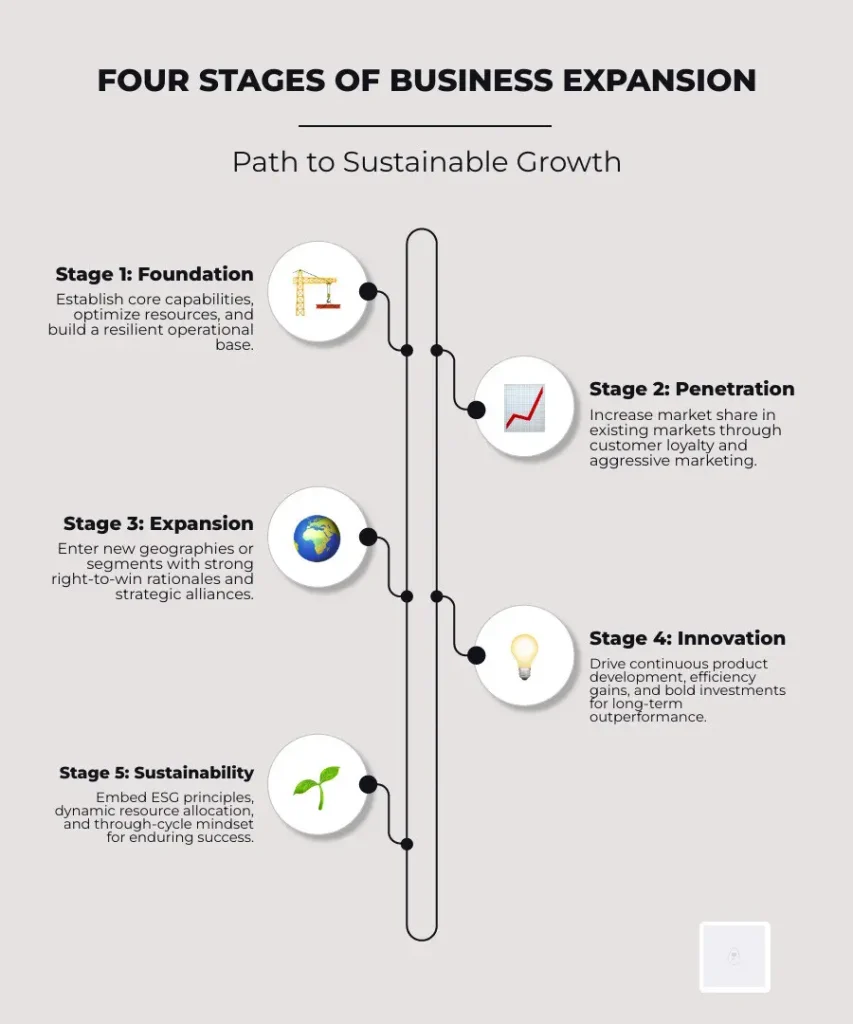
Market penetration is often the initial phase of any growth strategy, focusing on maximizing sales of current products or services within existing markets. This can be achieved through aggressive marketing campaigns, competitive pricing, expanding distribution channels, and enhancing customer service to build loyalty. For service-based businesses, this might involve loyalty programs, referral incentives, and personalized communication to deepen relationships with existing clients and attract new ones within the same geographic or demographic segment. Salesforce suggests that market penetration, like loyalty programs, is a foundational step before expanding into new services or markets.
Beyond penetrating existing markets, businesses seek to expand their reach. This can involve entering new geographical areas or targeting new customer segments. Geographic expansion, while offering significant growth potential, also entails challenges, including understanding local regulations, cultural nuances, and competitive landscapes. The SBA offers resources for businesses looking to expand to new locations, emphasizing the need to update marketing plans, ensure financial preparedness, and comply with all local laws.
When considering expansion into adjacent markets or new customer segments, businesses should employ “right-to-win rationales.” This concept, highlighted by McKinsey, suggests that successful expansions are those in which a company leverages its existing capabilities, addresses customer pain points, exploits value chain opportunities, or capitalizes on market disruptions. For example, a company with strong data analytics capabilities in one sector might expand into an adjacent sector where data insights are undervalued. By carefully assessing where their unique strengths provide a distinct advantage, businesses can strategically expand their market share and ensure sustainable, profitable growth.
Leveraging Innovation and Internal Efficiency
Innovation and internal efficiency are two sides of the same coin when it comes to driving sustained business growth. While innovation pushes the boundaries of what’s possible, efficiency ensures that these advancements are delivered profitably and sustainably.
Product Development and Continuous Innovation
Continuous innovation is not merely about launching new products; it’s about fostering a culture of creativity and adaptation across all facets of the business. This includes investing in research and development (R&D) to stay ahead of competitors and meet evolving customer needs. For service-based businesses, product development means refining existing services, creating new service packages, or developing proprietary tools and methodologies to enhance service delivery. The goal is to consistently offer value that keeps clients engaged and attracts new ones. This proactive approach ensures that a business remains relevant and competitive in a dynamic marketplace.
Operational Efficiency and Waste Reduction
Internal growth is significantly driven by operational efficiency. This involves streamlining processes, reducing waste, and optimizing resource allocation to improve profit margins without necessarily increasing sales volume. For example, a service firm might implement new project management software to reduce administrative overhead or optimize its client onboarding process to decrease the time spent per new client. By identifying and eliminating inefficiencies, businesses can free up resources—both capital and talent—to invest in growth initiatives. This focus on internal optimization ensures that the business is lean, agile, and capable of scaling effectively.
Maximizing Core Business Growth Strategies
While the allure of new markets and innovative products is strong, a significant portion of sustainable growth—around 80% according to McKinsey research—stems from maximizing the value of the core business. This means continuously optimizing and innovating within existing offerings and customer bases.
Modern businesses rely heavily on data to make smarter decisions. By combining analytics, automation, and practical CRM tools, companies can better understand customer behavior, improve communication, and identify sales opportunities earlier. This approach helps teams make faster decisions while maintaining stronger relationships with their clients.
Customer Relationship Management (CRM) systems are central to this strategy. A robust CRM helps manage customer interactions, track sales pipelines, and analyze customer data, enabling businesses to identify opportunities for upselling, cross-selling, and improving customer retention. Integrating CRM with AI and analytics creates a powerful growth engine, ensuring that every customer touchpoint is optimized for value. For service-based businesses, this means using CRM to track client history, anticipate needs, and proactively offer solutions, solidifying long-term relationships. Effectively leveraging these tools allows us to execute growth strategies with precision and measurable impact.
Scaling SMBs with Enterprise-Level Tools
Small and medium-sized businesses (SMBs) often face the challenge of competing with larger enterprises that boast extensive resources. However, modern technology has democratized access to powerful tools, enabling SMBs to achieve enterprise-level impact without a massive budget.
Automation and Lead Scoring: SMBs can leverage automation to streamline marketing and sales processes. Automated email campaigns triggered by customer actions, such as form submissions or downloads, ensure consistent communication. Lead scoring, based on prospect behavior and interests, helps sales teams prioritize the most promising leads, optimizing their efforts.
Sales Playbooks: Just as a sports team needs a clear game plan, a sales playbook provides a structured approach for B2B sales. It defines the vision, outlines the sales process, and helps create buyer personas. While flexible, a playbook ensures consistency and efficiency, especially as the sales team grows.
Collaboration Platforms: Tools like Slack can transform internal communication and even serve as “mini-CRMs.” By using channels and threads, teams can centralize customer conversations, discuss solutions privately, and turn messages into actionable items. This keeps communication organized and accessible, fostering better collaboration.
Digital Marketing and SEO-focused Content: The power of digital marketing, particularly SEO-focused content and insights from leading digital marketing companies, cannot be overstated for SMBs. As seen with Zapier, which generated 72% of its organic website traffic from SEO-focused blogs in 2023, investing in valuable content can drive significant organic growth. This approach builds authority, attracts qualified leads, and establishes a strong online presence. By embracing these tools and strategies, SMBs can scale their operations, enhance customer experience, and compete effectively in their respective markets.
Strategic Expansion Through Partnerships and Acquisitions
Beyond internal efforts, external strategies like strategic partnerships and acquisitions offer powerful avenues for accelerating business growth. These approaches allow businesses to expand their reach, capabilities, and market share more rapidly than organic methods alone.
Strategic Alliances and Joint Ventures
Strategic alliances and joint ventures involve collaborating with other businesses to achieve common goals. These partnerships can expand customer bases, create unique service offerings, or facilitate entry into new markets. For example, a ride-sharing app partnering with a fast-food chain enhances customer convenience and broadens both companies’ service ecosystems. Such alliances can also lead to value chain expansion, where businesses integrate their offerings to provide a more comprehensive solution to customers. This can even be a catalyst for market disruption, as new, integrated services challenge existing market norms. The key is to find partners whose values align with ours and whose strengths complement our own, creating a mutually beneficial relationship that drives growth.
Inorganic Business Growth Strategies
Inorganic growth, primarily through mergers and acquisitions (M&A), provides a rapid pathway to expansion. Acquiring another company can instantly boost market share, add new product lines, or bring in critical talent and technology. However, successful M&A is not just about buying revenue; it should be capabilities-driven. As noted in research, capabilities-driven acquirers often outperform others by significant margins in total shareholder returns. This means acquiring companies that enhance our core strengths or provide a “right-to-win” in new areas.
Conversely, “shrinking to grow” is a strategic approach that involves divestitures—selling off non-core or underperforming assets. This seemingly counterintuitive strategy allows businesses to reallocate capital and talent to higher-potential areas, improving overall efficiency and focus. For companies without consistent growth engines, periodic portfolio reallocation through divestitures can create a healthier, more growth-oriented base. This dynamic management of the business portfolio ensures that resources are always directed towards opportunities with the greatest potential for profitable growth.
Navigating Risks in New Geographies
Expanding into new markets or geographies presents exciting growth opportunities but also significant risks. Businesses must carefully navigate a complex landscape of economic volatility, evolving consumer demands, and stringent regulatory compliance.
Economic Volatility and Consumer Demand Shifts: New markets can be subject to different economic cycles and political instabilities. Furthermore, consumer preferences and purchasing behaviors can vary significantly across regions. What works in one market may not resonate in another, requiring extensive market research and product or service adaptation. For instance, a business might need to adjust its pricing strategy, marketing messages, or even its core service offering to suit local tastes and economic conditions.
Regulatory Compliance: Each country or region has its own set of laws and regulations governing business operations, labor practices, taxation, and data privacy. Non-compliance can lead to hefty fines, legal battles, and reputational damage. It’s crucial to invest in legal and regulatory expertise to ensure full adherence from the outset. The SBA, for example, provides guidance for businesses expanding to new locations, emphasizing the need to comply with all local laws.
Financial Resilience and Revenue Diversification: To mitigate these risks, businesses expanding geographically need strong financial resilience. This means having sufficient capital reserves to absorb initial losses and a clear understanding of the investment required. Diversifying revenue streams across different geographies or product lines can also reduce dependence on any single market, increasing overall stability and long-term sustainability. Without careful planning and risk mitigation, geographical expansion can quickly become a costly endeavor.
Building a Culture of Outperformance and Sustainability
Sustainable business growth is not solely dependent on strategies and market conditions; it is deeply rooted in the organizational culture and the capabilities of its people. Building a culture that fosters innovation, empowers employees, and prioritizes long-term value creation is paramount for outperformance.
Innovation Culture and Employee Development
An innovation culture is one where new ideas are encouraged, experimentation is valued, and continuous learning is the norm. Companies that consistently outperform often discuss innovation on earnings calls twice as often as their peers, indicating a deep-seated commitment. This requires investing in employee development through training, mentorship, and providing opportunities for skill-building. When employees feel empowered and equipped with the right skills, they are more likely to contribute creative solutions and drive efficiency. This also fosters an ownership mindset, where individuals take accountability for their roles in the company’s growth journey, leading to higher talent retention and overall organizational strength.
The Role of ESG and Sustainability
In today’s global landscape, sustainability and Environmental, Social, and Governance (ESG) initiatives are no longer just ethical considerations; they are powerful accelerants for profitable growth. Research indicates that “triple outperformers”—companies that achieve growth, profits, and sustainability—generate an additional 5-7 percentage points of total shareholder return (TSR) compared to their peers.
Integrating ESG principles into the core business strategy can enhance brand reputation, attract socially conscious customers and investors, improve operational efficiency (e.g., through energy savings), and mitigate regulatory risks. For service-based businesses, this might involve adopting eco-friendly practices, promoting diversity and inclusion, or engaging in community outreach. When sustainability is viewed not as a cost center but as a strategic advantage, it can unlock new markets, foster innovation, and build stronger, more resilient businesses. This approach demonstrates that profitable growth and positive societal impact can, and should, go hand-in-hand.
Traits of Consistent Growth Outperformers
What distinguishes companies that consistently outperform their peers in growth? Research points to several common traits that enable sustained success:
- Dynamic Resource Allocation: Outperformers are adept at reallocating capital and talent to their highest-potential growth opportunities. They are willing to shut down underperforming projects and redirect resources to new ventures, ensuring that investments are always aligned with strategic priorities. This agility in resource deployment is crucial for adapting to changing market conditions.
- Bold Moves and Functional Capabilities: These companies are not afraid to make bold bets, especially during periods of disruption. They continuously invest in building and enhancing functional capabilities in areas such as digital marketing, advanced analytics, and innovation, which serve as competitive differentiators.
- Through-Cycle Investment: Consistent outperformers maintain a long-term perspective, investing in growth initiatives even during economic downturns. This through-cycle commitment allows them to emerge stronger when markets recover.
- High Growth Rates: Half of the “triple outperformers” (growth, profit, sustainability) reached or exceeded 10% annual revenue growth between 2017 and 2021, a period when fewer than one in four companies did so. This demonstrates that a combination of strategic foresight, operational excellence, and a commitment to sustainability can lead to exceptional financial results.
These traits, collectively, create a powerful engine for sustained growth, enabling businesses not only to survive but to thrive in competitive environments.
Frequently Asked Questions about Business Growth Strategies
What are the most common pitfalls to avoid when scaling?
Scaling a business is fraught with potential missteps. One common pitfall is over-diversification, where companies expand into too many unrelated areas without a clear strategic link or sufficient capabilities. This can dilute focus and strain resources. Another significant error is neglecting the core business in pursuit of new ventures, which can undermine the foundational revenue streams. Owner dependency is also a major hurdle for SMBs; if operations are not systematized, the business becomes too reliant on the owner, hindering scalability. Furthermore, failing to audit capabilities before expanding can lead to entering markets where a business lacks a “right to win.” Finally, ignoring customer feedback can result in developing products or services that don’t meet market needs, leading to wasted investment and lost opportunities.
How do businesses measure the success of a growth strategy?
Measuring the success of a growth strategy requires a holistic approach that looks beyond top-line revenue. Key metrics include:
- Revenue Growth Rate: The percentage increase in revenue over a specific period.
- Profit Margins: Ensuring that growth is profitable and not just increasing sales at any cost.
- Customer Lifetime Value (CLV) and Customer Acquisition Cost (CAC): These metrics measure the long-term value of customers relative to the cost to acquire them.
- Market Share: An indicator of a business’s penetration and influence within its target markets.
- Total Shareholder Return (TSR): For publicly traded companies, this reflects the total return to shareholders.
- Customer Satisfaction and Retention Rates: High satisfaction and retention are strong indicators of sustainable growth and loyalty.
- Employee Engagement and Productivity: A motivated, efficient workforce is crucial to executing growth initiatives.
By tracking a balanced scorecard of these financial and operational indicators, businesses can gain a comprehensive understanding of the effectiveness of their growth strategy.
Why do only 25% of companies achieve sustainable growth?
The rarity of sustainable growth is attributable to several factors. Firstly, a lack of courage often prevents companies from making the bold, strategic moves necessary to outperform, especially during uncertain economic times. Many opt for caution, which can lead to stagnation. Secondly, poor resource allocation—inefficient deployment of capital and talent—can stifle promising initiatives and waste potential. Thirdly, a failure to innovate and adapt to market changes leaves businesses vulnerable to disruption. Complacency, or sticking to the status quo, is a significant barrier. Finally, an inability to adapt to market disruptions—whether technological, behavioral, or competitive—means companies cannot pivot effectively, leading to declining relevance and eventual failure. Sustainable growth requires a proactive, adaptable, and courageous approach.
Executing Your Growth Roadmap
Developing a robust business growth strategy is only half the battle; the true differentiator lies in its execution. Without rigorous implementation, even the most brilliant strategies remain theoretical. This demands a commitment to execution excellence, ensuring that every initiative, from market penetration to product development, is meticulously planned and flawlessly delivered.
Leadership alignment is critical. The entire leadership team, from the C-suite to departmental heads, must be unified in their understanding of the growth aspirations and the strategic roadmap. This alignment ensures that resources are channeled effectively and that all efforts are coordinated towards common objectives.
For investments in new ventures or breakout opportunities, stage-gated investments provide a structured approach. This involves setting clear milestones and evaluating progress at each stage, with the discipline to ‘pull the plug’ if a venture isn’t meeting its targets. This prevents throwing good money after bad and ensures dynamic resource allocation.
Effective performance management and clear Key Performance Indicators (KPIs) are essential for tracking progress, holding teams accountable, and making data-driven adjustments. These metrics provide real-time insights into what’s working and what needs refinement.
The goal is long-term system survival and scalability. By embedding a culture of continuous improvement, fostering innovation, and building scalable processes, businesses can ensure their growth is not just a temporary surge but a sustainable trajectory. A well-executed growth roadmap acts like a lighthouse, guiding the business through turbulent waters towards lasting prosperity and market leadership.
Ready to transform your business growth?
Discover how strategic systems can unlock your full potential. Learn more about our digital marketing solutions