
Investing in the right air conditioning system is one of the most significant decisions you can make for your home’s comfort, health, and energy efficiency. With so many options on the market, choosing the system that best suits your unique needs can feel overwhelming. Whether you are building a new house or upgrading your current HVAC unit, it is important to weigh all considerations carefully. For instance, those looking for AC installation in Woodbridge, VA must consider both the regional climate and the specific layout of their home when making their choice.
Before you select a unit, take stock of multiple factors such as efficiency, capacity, and technology. A system that is perfect for one household may not meet the needs of another, depending on the square footage, insulation, or even the number of windows. Setting clear priorities and understanding what each type of air conditioner offers can help ensure your comfort for years to come. Homeowners who balance both the initial investment and long-term savings will discover that time spent researching pays big dividends.
Table of Contents
Assess Your Home’s Size and Layout
The dimensions and floor plan of your home are crucial starting points when choosing an air conditioning system. If your home is too large for a given unit, it will be inefficient, operating continuously without delivering the desired comfort. An oversized system, on the other hand, may cool quickly but fail to manage humidity, resulting in a clammy indoor environment. An accurate assessment of your space, considering both its total square footage and any open areas such as vaulted ceilings or sunrooms, is necessary to ensure proper sizing. Online BTU calculators can offer a basic estimate, but it’s better to choose a trusted technician for home AC servicing to ensure proper sizing and installation.
Understand Different Types of AC Systems
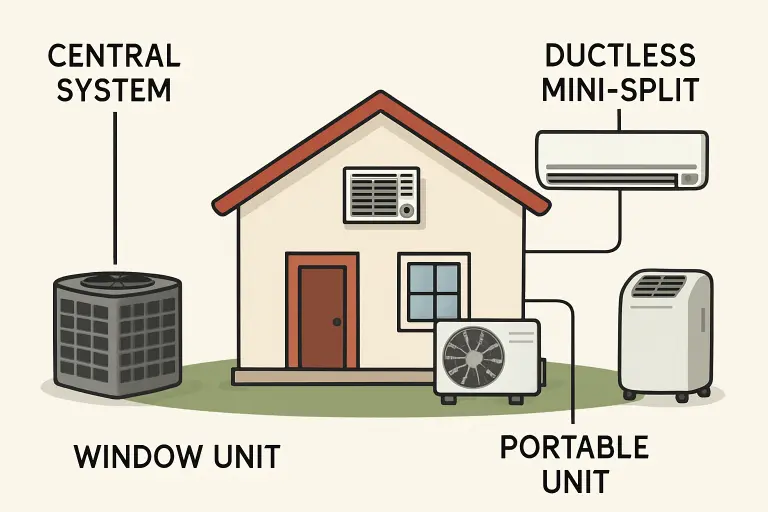
There are several distinct options available for air conditioning, each with unique benefits and limitations:
- Central Air Conditioning: The best solution for comprehensive cooling throughout large homes. Central AC systems rely on ductwork to distribute air evenly and can often be paired with heating systems for year-round climate control.
- Ductless Mini-Split Systems: Perfect for homes that lack existing ductwork, renovations, or additions. These units can be installed in specific rooms, enabling zoned cooling and greater flexibility.
- Window Units: Suitable for single rooms or smaller spaces. They are easy to install and budget-friendly, but are typically less aesthetically pleasing and may block window views.
- Portable Units: Convenient and mobile, making them a flexible alternative for renters or temporary needs, though they are generally less powerful and efficient than other types.
Take time to understand which system matches your home’s needs and your long-term expectations for comfort and efficiency.
Evaluate Energy Efficiency Ratings
Energy efficiency is one of the primary factors that will affect your utility expenses and environmental impact over time. Modern air conditioners carry a SEER (Seasonal Energy Efficiency Ratio) rating; higher numbers indicate better efficiency. Look for units rated at least 14 SEER, although some high-efficiency systems offer ratings above 20. Not only do energy-efficient models lower your monthly bills, but some may also qualify for local rebates or tax incentives.
Consider Climate and Usage Patterns
The climate where you live plays an important role in selecting the right system. Homeowners in humid, coastal, or southern regions may benefit from systems with enhanced dehumidification capabilities or variable-speed compressors, which allow the unit to ramp up and down in response to temperature changes. Additionally, consider how often your system will be in use. If you rarely use air conditioning, a window unit or a portable option might be sufficient.
Factor in Installation and Maintenance
The durability and performance of any air conditioner depend on professional installation and regular care. Incorrect installation can hinder efficiency and reliability, so it’s important to find the best air conditioning repair company to avoid costly issues. Technicians will verify that the unit is properly sized, charged with refrigerant, and fully functional before sign-off. Scheduled maintenance, such as changing air filters, checking the coil, and cleaning drains, extends your system’s life. Working with an air conditioning contractor makes it easier and more reliable.
Explore Advanced Features and Technology
Many newer air conditioning models incorporate advanced features to increase convenience, control, and savings. Smart thermostats, for example, allow homeowners to set and adjust temperatures via smartphone apps, ensuring comfort and savings even when no one is home. Variable-speed compressors and multi-stage cooling capacities provide steadier temperatures while keeping energy consumption lower. Some systems even integrate with home automation platforms, adding an extra layer of convenience and efficiency to your home.
Budget and Financing Options
Budget remains an important consideration as you narrow your choices. Higher-efficiency units cost more up front, but lower monthly bills and potential incentives can more than offset the difference over the system’s lifespan. Research available financing, manufacturer rebates, and government tax credits, especially when installing an Energy Star-certified or variable speed system. Always get multiple quotes and ask about payment plans that can ease higher installation costs.
Conclusion
Choosing the most suitable air conditioning system requires a thorough evaluation of your space, energy needs, local climate, and maintenance expectations. By exploring the options, consulting HVAC professionals, and focusing on both comfort and performance, you will find a solution that delivers lasting benefits for your family and your wallet. Stay informed, seek expert guidance, and invest wisely to enjoy a cool and comfortable home for years to come.