

The Architecture of Modern Digital Marketing Strategies

The digital landscape is always changing. For modern businesses, simply having an online presence is no longer enough. To truly succeed, we need a clear roadmap: a well-defined digital marketing strategy. Without one, our marketing efforts can feel disjointed, leading to wasted resources and missed opportunities.
A strong strategy helps businesses stay focused and consistent across channels. Using digital marketing services can streamline campaigns, improve targeting, and drive better overall ROI.
In this guide, we will explore the core elements of advanced digital marketing strategies. We will look at how to build, implement, and measure effective plans. We will also dive into the latest trends and technologies, like AI, that are shaping the future of online marketing. Our goal is to equip you with the knowledge to thrive in today’s competitive digital world. This includes understanding the continuous refinement needed, often through a robust conversion rate optimization process.
Before we dive into the specifics, it’s crucial to understand the fundamental difference between a digital marketing strategy, a plan, and individual tactics. A strategy is our high-level vision, defining what we want to achieve and why. A plan is the detailed roadmap outlining how we’ll get there, including timelines and resource allocation. Tactics are the specific actions we take, such as running a Facebook ad or publishing a blog post. Without a clear strategy, our plans and tactics lack direction and purpose.
A robust digital marketing strategy serves as the blueprint for all our online efforts, aligning them with overarching business objectives. It’s a long-term vision that dictates how we allocate resources, target audiences, and position our brand to gain a competitive advantage. Without this foundational architecture, even the most innovative tactics can fall flat.
At its core, a successful digital marketing strategy comprises several essential components. These include clearly defined goals, a deep understanding of our target audience, realistic budget parameters, and a brand positioning statement that resonates. Furthermore, multi-channel integration is paramount, ensuring a cohesive and consistent customer experience across all digital touchpoints. Industry data highlights the urgency: a significant 47% of companies still operate without a planned digital marketing strategy, underscoring a vast opportunity for those who invest in strategic foresight (Smart Insights). For businesses aiming for truly impactful results, exploring Elite digital marketing strategies can provide the advanced insights needed to stand out.
Table of Contents
Developing Multi-Channel Digital Marketing Strategies
In today’s fragmented digital landscape, customers interact with brands across numerous platforms. This necessitates an omnichannel experience where every customer touchpoint, from search engine results to social media engagement and email nurturing, works in harmony. Our goal is to ensure brand consistency and a seamless journey, regardless of the channel.
This involves balancing organic growth strategies, like content marketing and SEO, with paid media efforts such as PPC. The key is cross-channel attribution, understanding how each channel contributes to the overall customer journey and conversion. For example, a customer might discover us through a social media ad, research on Google, read a blog post, and finally convert after receiving an email. A multi-channel strategy tracks and optimizes this entire path.
Aligning Business Goals with SMART Framework
Every effective digital marketing strategy begins with clearly defined goals. We advocate for the SMART framework: goals that are Specific, Measurable, Achievable, Relevant, and Time-bound. This ensures our objectives are not vague aspirations but concrete targets that can be tracked and evaluated.
For instance, instead of aiming to “increase website traffic,” a SMART goal might be to “grow organic website sessions by 25% within the next six months.” Once SMART goals are established, regular employee performance review processes help ensure teams stay aligned with objectives and continuously improve execution. Performance benchmarks, derived from historical data or industry averages, provide context for our results. Studies show that clear goals significantly improve team performance, with 98% of companies reporting better visibility into performance after using clear goal systems (Mooncamp).
Core Pillars of High-Performance Digital Marketing
To build a truly high-performance digital marketing strategy, we recognize four interconnected pillars: Search Engine Optimization (SEO), Paid Advertising (PPC & Social Ads), Content Marketing, and Conversion Rate Optimization (CRO). These pillars, when integrated effectively, create a synergistic growth engine.
| Feature | Search Engine Optimization (SEO) | Pay-Per-Click (PPC) Advertising |
|---|---|---|
| Goal | Drive organic traffic, build authority, long-term visibility | Drive immediate traffic, generate leads/sales, quick visibility |
| Cost Model | Ongoing investment in content, technical SEO, link building; no direct click cost | Pay per click (CPC), impression (CPM), or conversion (CPA) |
| Time to Results | 3–6 months for significant impact, compounding over time | Immediate visibility, results within days |
| Control | Less direct control over rankings; depends on algorithm updates | Full control over ad copy, targeting, budget, and placement |
| Sustainability | Sustainable long-term asset, builds brand equity | Requires continuous budget; stops when budget runs out |
| Focus | E-E-A-T, topical authority, keyword intent, user experience | Keyword bidding, audience targeting, ad creative, landing page optimization |
Content Velocity and Authority Building
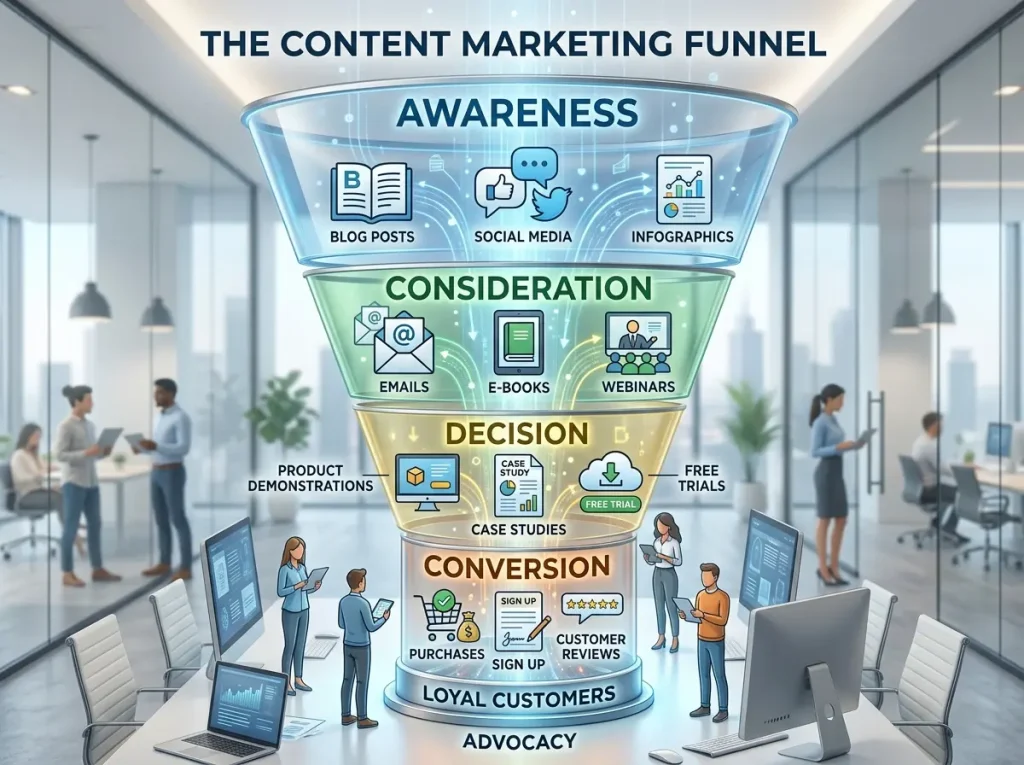
Content marketing is the engine that fuels many digital strategies, particularly SEO. It’s about creating and distributing valuable, relevant, and consistent content to attract and retain a clearly defined audience. This pillar emphasizes building topical authority, demonstrating expertise, experience, authoritativeness, and trustworthiness (E-E-A-T) to both search engines and users.
We focus on creating content silos, where broad topics are broken down into pillar pages supported by numerous cluster content pieces. This structured approach helps search engines understand our expertise and improves our rankings. User-generated content, thought leadership articles, video marketing, and storytelling all contribute to a rich library of educational resources. This content is then strategically distributed across channels, with engagement metrics providing feedback for continuous improvement. While not a quick win, SEO is a long-term asset that pays dividends for years, with 53% of all website traffic coming from organic search, and B2C companies seeing an average ROI of 721% (Upskillist, First Page Sage). Furthermore, companies using content marketing generate three times as many leads at 62% lower cost (SEO.com).
Precision Targeting in Paid Media
Paid advertising, encompassing PPC and social media ads, offers instant visibility and precise targeting capabilities. It allows us to reach specific audience segments with tailored messages, driving immediate traffic and conversions. Platforms like Google Ads (formerly Google AdWords) and Meta Ads (Facebook & Instagram) provide sophisticated tools for this.
Key to success in paid media is meticulous audience segmentation, creating custom and lookalike audiences based on demographics, interests, and behaviors. Retargeting campaigns allow us to re-engage users who have previously interacted with our brand. We also optimize for factors like dayparting (scheduling ads for peak engagement times) and bid optimization to maximize our return on ad spend. Continuous A/B testing of ad creatives, landing page relevance, and quality scores is vital. Priceline, for example, reportedly spent over $3 billion on PPC in 2016, demonstrating the potential scale and impact of this channel (FSE Digital).
Data-Driven Execution and Future-Proofing
In an increasingly complex and privacy-conscious digital world, data-driven execution is non-negotiable. Future-proofing our digital marketing strategies means adapting to evolving consumer expectations and technological advancements, particularly regarding privacy-first marketing and the deprecation of third-party cookies.
This shift places a premium on first-party data – information we collect directly from our customers through website analytics, customer accounts, purchase history, and email engagement. This data fuels personalization and allows for more accurate targeting while respecting user privacy. By the end of 2024, digital channels were estimated to make up 60% of total marketing spend, highlighting the ongoing shift away from offline media (MarketingCharts).
How AI is Transforming Digital Marketing Strategies
Artificial Intelligence (AI) has rapidly become a game-changer, fundamentally altering how we approach digital marketing strategies in 2025 and beyond. AI tools, including generative AI like ChatGPT and WRITER, are streamlining tasks such as content creation, automated copywriting, and email drafting. This frees up human marketers to focus on higher-level strategy and creativity.
Beyond content, AI is empowering predictive lead scoring, identifying sales-ready prospects with greater accuracy. Chatbots and AI agents provide 24/7 customer support, enhancing user experience and nurturing leads. Dynamic content personalization, adapting to individual behavior in real-time, is becoming standard practice. AI also optimizes ad spend through automated bid optimization, ensuring our budgets are used efficiently. The most successful brands, like McDonald’s, are undergoing massive digital transformations by tapping into AI to deliver personalized, AI-powered service to customers (McDonald’s Instagram).
Optimizing for Voice Search and Emerging Levers
As voice assistants like Siri, Alexa, and Google Assistant become ubiquitous, optimizing for voice search is an increasingly important lever. This involves using conversational keywords, structuring content in an FAQ format, and aiming for featured snippets that voice assistants often use for answers. Natural language processing (NLP) is key to understanding user intent in spoken queries.
Beyond voice search, other emerging levers include the continued dominance of video marketing, especially short-form video on platforms like TikTok and Instagram. Influencer collaborations and affiliate networks remain powerful for leveraging trust and reaching niche audiences; the affiliate marketing industry was estimated to be a $13 billion industry in 2023 (Influencer Marketing Hub). Mobile-first indexing and responsive web design are critical, as the average time spent on the phone daily in the U.S. is expected to reach 4 hours and 39 minutes by 2024 (Statista). More than half of consumers reply to texts within two minutes, and 70% have opted in to receive texts from businesses, making SMS marketing a potent channel (SimpleTexting).
Measuring Success and Revenue Impact
Measuring the success of our digital marketing strategies is not just about tracking vanity metrics; it’s about understanding their tangible impact on revenue and business growth. This requires a robust analytics framework and a focus on KPIs that directly correlate with our financial objectives.
Identifying KPIs That Drive Growth
To truly drive growth, we must move beyond surface-level metrics and focus on Key Performance Indicators that directly impact the bottom line. These include:
- Revenue Growth: The ultimate measure of success.
- Lead Quality and Quantity: Ensuring we’re attracting the right prospects.
- Sales Cycle Length: Optimizing the time it takes to convert a lead into a customer.
- Customer Retention and Churn Rate: Nurturing existing customers and minimizing attrition.
- Customer Lifetime Value (CLTV): Understanding the long-term profitability of each customer.
- Return on Ad Spend (ROAS): Measuring the revenue generated for every dollar spent on advertising.
- Customer Acquisition Cost (CAC): The cost of acquiring a new customer.
- Conversion Rate: The percentage of visitors who complete a desired action.
- Brand Sentiment and Social Share of Voice: Gauging public perception and market presence.
- Email Open Rates and Click-Through Rates: Indicators of engagement and content relevance.
These KPIs help us understand not just what’s happening, but why it’s happening, allowing for informed strategic adjustments.
Continuous Optimization and A/B Testing
Digital marketing is an iterative process. Continuous optimization is essential, driven by data from our KPIs. This involves regular testing and refinement of our strategies and tactics. A/B testing allows us to compare different versions of ads, landing pages, email subject lines, or website elements to determine which performs best. Multivariate testing takes this a step further, testing multiple variables simultaneously.
Tools like heatmaps and user behavior analysis help us understand how visitors interact with our websites and content. Technical SEO audits and page speed optimization are crucial for maintaining search engine performance and user experience. With 41.6% of emails viewed on mobile devices in 2021, ensuring mobile responsiveness and an intuitive user experience design across all our digital assets is paramount (Litmus). This iterative approach, combined with a commitment to continuous improvement, ensures our strategies remain effective and adaptable.
Industry-Specific Strategic Adaptations
Digital marketing strategies are not one-size-fits-all. They must be tailored to the specific nuances of different industries and business models.
For B2B marketing, the focus is often on lead generation, thought leadership, and building long-term relationships. Strategies commonly include SEO-optimized content marketing, account-based marketing (ABM) to target high-value accounts, LinkedIn marketing (96% of B2B content marketers use LinkedIn, and say it’s a top-performing platform for organic traffic), and email nurture campaigns. The sales cycle is typically longer and more complex, requiring sustained engagement.
B2C e-commerce strategies prioritize driving direct sales, building brand loyalty, and creating engaging customer experiences. This involves strong visual content, social media marketing, influencer collaborations, email marketing with personalized recommendations, and seamless website user experience. Retail e-commerce sales were estimated to surpass $6.3 trillion worldwide in 2024 (Statista).
SaaS growth strategies often blend elements of B2B and B2C, focusing on customer acquisition, activation, retention, and upsell. Content marketing (e.g., product tutorials, case studies), performance advertising, email onboarding sequences, and in-app messaging are common.
For local businesses or service providers, like those in the construction sector, strategies revolve around local SEO, Google My Business optimization, online reviews, and geo-targeted ads. For example, Digital marketing for roofers would emphasize local search visibility, reputation management, and lead capture through mobile-friendly websites and targeted PPC campaigns.
Each industry requires a deep understanding of its customer journey, competitive landscape, and unique selling propositions to craft truly effective strategies.
Frequently Asked Questions about Digital Marketing Strategies
What is the difference between a digital marketing strategy and a tactic?
A strategy is the high-level framework and long-term vision that defines business goals and audience targeting, while tactics are the specific actions, such as a single social media post or a specific keyword bid, used to execute that strategy.
How long does it take to see results from a new digital marketing strategy?
Paid strategies like PPC can generate traffic and leads almost immediately, whereas organic strategies like SEO and content marketing typically require three to six months to show significant compounding results and authority growth.
How much should a business budget for digital marketing?
While it varies by industry, a common benchmark is to allocate 7% to 10% of total revenue to marketing, with approximately 50% to 60% of that budget dedicated specifically to digital channels to remain competitive in a digital-first economy (SingleGrain).
Conclusion
In an ever-evolving digital landscape, a well-crafted digital marketing strategy is no longer a luxury but a fundamental necessity for modern businesses. It provides the strategic agility required to navigate technological shifts, changing consumer behaviors, and competitive pressures. By integrating data, embracing adaptive frameworks, and maintaining a consumer-centric approach, we can unlock sustainable growth and achieve a strong marketing ROI. The future of digital marketing demands continuous learning, experimentation, and a commitment to building a robust, integrated strategy that drives long-term success.