

Key Takeaways
- Smart warehousing relies on automation, IoT, and AI to enhance supply chain efficiency and accuracy.
- Investing in intelligent warehousing technology yields measurable cost savings and higher customer satisfaction.
- Barriers to adoption include the need for upfront capital, complex integration, and workforce training.
In today’s rapidly evolving business landscape, companies are under pressure to deliver goods faster and more accurately than ever before. Managing supply chains efficiently can be the difference between retaining customers and losing them to competitors. One of the most significant advancements in this space is the integration of smart technologies into warehouse operations. As firms seek to modernize, the demand for industrial warehousing South Carolina and similar regional hubs continues to grow, highlighting the strategic shift toward digitized logistics.
Smart warehousing solutions rely on automation and strong data management practices to improve transparency and keep operations running smoothly. This digital transformation enables real-time inventory management and proactive issue resolution, helping businesses better anticipate demand and swiftly address supply challenges. By implementing intelligent warehousing methods, companies can significantly reduce lead times, minimize operational risks, and improve customer service across different locations. Traditional warehousing models, relying on manual inventory processes and isolated systems, are becoming insufficient amidst the rising demands of e-commerce and customer expectations. Smart warehousing addresses these challenges by leveraging technologies such as robotics, the Internet of Things (IoT), and artificial intelligence (AI), delivering the agility and insights needed to maintain competitiveness. Furthermore, companies that adopt smart warehousing solutions can rapidly scale their operations and adapt to changing demand, making digital logistics infrastructure essential for supply chain resilience, especially in rapidly developing regions.
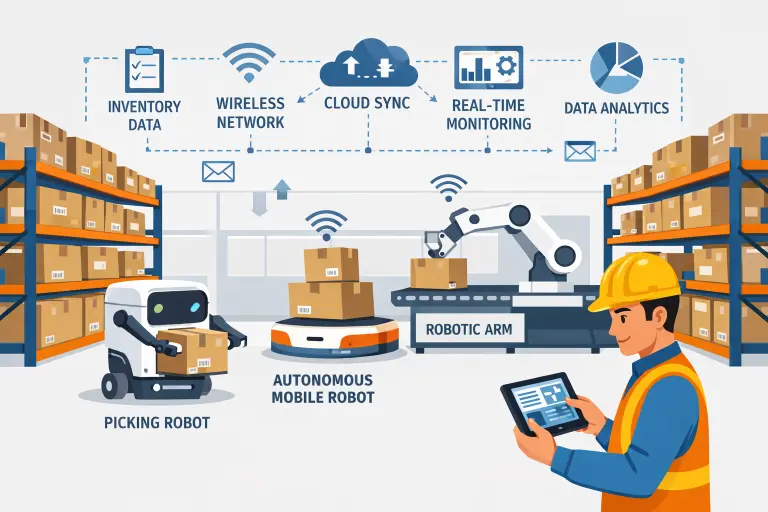
Table of Contents
Core Components of Smart Warehousing
Several advanced technologies now form the backbone of modern warehouses, each offering unique advantages in the pursuit of operational excellence.
- Automation: Robotics and automated systems handle repetitive processes such as order picking, sorting, and packaging. This reduces human error, improves throughput, and creates safer working environments for warehouse staff.
- IoT Devices: Sensors and connected equipment help monitor inventory levels, equipment status, environmental conditions, and shipment progress in real time. Data collected by IoT devices informs timely decision-making and can trigger automated responses.
- AI and Machine Learning: These technologies analyze supply chain data to forecast trends, detect anomalies, and optimize resource allocation. Predictive analytics enable warehouses to maintain optimal inventory and avoid costly disruptions.
Benefits of Smart Warehousing
Embracing smart warehousing significantly enhances supply chain management across multiple dimensions. Firstly, it increases efficiency through automated workflows that expedite warehouse operations, resulting in quicker order fulfillment and inventory reconciliation, thereby improving delivery times for customers. Secondly, it delivers cost savings by eliminating redundant labor and reducing errors, which lowers operational expenses. Moreover, better inventory control and reduced waste help lower holding costs over time. Finally, smart warehousing improves customer satisfaction by ensuring accurate, on-time deliveries, facilitated by streamlined operations and reliable inventory tracking, thereby enhancing customer loyalty and reducing complaints.
Challenges in Implementation
Despite the clear benefits, setting up a smart facility starts with the right warehouse construction approach and thoughtful planning.
- High Initial Investment: Procuring and deploying advanced technologies can be expensive, especially for small or mid-sized businesses. The return on investment, however, is typically strong over the long term.
- Integration Complexity: Smart systems must interface seamlessly with existing infrastructure, which can be technically challenging. Mismatches between legacy and new systems may introduce delays or operational hiccups during transition.
- Workforce Adaptation: Employees will require new skills to work alongside advanced systems, prompting companies to invest in training and change management to ensure a smooth shift.
Real-World Examples
Global leaders across different sectors offer clear demonstrations of smart warehousing’s impact. For example, a Finnish engineering company reduced procurement errors and improved part sourcing by leveraging cloud-based Product Lifecycle Management (PLM) systems. Their adoption of digital collaboration tools led to higher productivity and lower fulfillment errors, demonstrating the real-world value of integrated warehousing technologies.
Amazon is perhaps the most widely recognized example of smart warehousing in practice. With fulfillment centers staffed by robots and powered by data-driven systems, Amazon consistently excels at rapid, accurate order delivery. These examples underscore how advanced tools can redefine logistics, streamline processes, and drive business growth.
Future Trends
The trajectory of smart warehousing is advancing as organizations increasingly recognize its benefits and new innovations arise. Key trends shaping the future of this sector include: the increased use of AI, which will enhance supply chain optimization through intelligent automation and predictive analysis; the expansion of IoT, leading to the generation of richer, multi-dimensional data that supports improved decision-making regarding inventory management and system maintenance; and a strong focus on sustainability, where energy-efficient robots, smart lighting, and data-driven environmental controls are crucial for lowering the carbon footprint and meeting corporate sustainability objectives.
Conclusion
The shift to smart warehousing solutions marks a fundamental transformation in supply chain management. By integrating cutting-edge technologies, companies gain operational efficiencies, greater accuracy, and a competitive edge. While challenges such as high costs and workforce adaptation require thoughtful attention, the benefits far outweigh the initial hurdles. Businesses that embrace smart warehousing today are well-positioned to navigate tomorrow’s fast-paced, ever-changing logistics landscape.