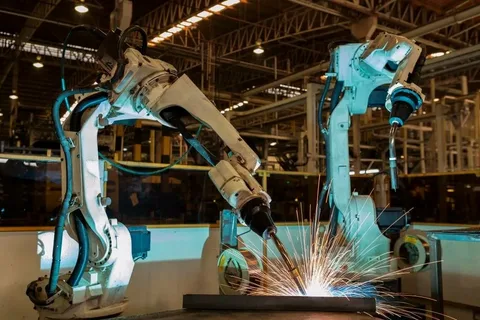

Manufacturers around the world are turning to industrial cobots to boost productivity and streamline operations. Unlike traditional robots that require safety cages and complex programming, industrial cobots are flexible, easy to integrate, and cost-effective, making them an ideal solution for both large factories and small production lines.
These collaborative robots are built to work safely alongside human workers, handling repetitive or physically demanding tasks while improving overall efficiency. In this post, we’ll explore the top benefits of using industrial cobots in production and how they can help businesses stay competitive in today’s fast-paced market.
Table of Contents
Reduction of Production Costs
Cobots significantly reduce operational expenses by automating routine, repetitive, or physically demanding tasks that would otherwise require human labor. This results in:
- Labor costs are reduced because cobots handle repetitive tasks, requiring fewer workers for routine jobs.
- Minimized human errors, improved product quality, and reduced rework or waste.
- Energy and space savings, as cobots are compact and require less infrastructure than traditional robots.
For small and medium-sized enterprises (SMEs), this affordability makes cobots a practical solution for staying competitive without needing heavy upfront investments. Cobots deliver a strong return on investment (ROI) by cutting costs while boosting productivity.
Easy Setup and Fast Deployment
Traditional industrial robots often demand specialized engineers, long installation times, and extensive training. In contrast, cobots are:
- Plug and play – many cobots can be set up and ready to use in just a few days, instead of taking weeks.
- Intuitive to program – interfaces like TMflow allow staff with no coding background to set up tasks using drag-and-drop functions.
- Easily re-deployable – cobots can be quickly reassigned to new tasks when production needs change, helping businesses stay agile.
This simplicity makes cobots ideal for companies that face fluctuating demand or need to respond quickly to market changes.
Versatile Across Industries
Cobots are not limited to one industry, they adapt to many. Examples include:
- Manufacturing: Assembly, welding, polishing, and quality inspection.
- Logistics: Picking, packing, palletizing, and sorting.
- Healthcare: Assisting in lab testing, dispensing medication, and supporting surgeries.
- Agriculture: Harvesting crops, planting, and monitoring soil conditions.
Cobots are flexible robots that speed up work and replace multiple machines.
Empowering Employees
Rather than replacing workers, cobots are designed to collaborate with them. This results in:
- Cobots create safer workplaces by handling dangerous or heavy tasks.
- Employee morale improves because cobots take over boring, repetitive tasks.
- Cobots help workers grow by letting them focus on creative and problem-solving tasks.
Cobots do boring or dangerous jobs so people can focus on thinking, creating, and watching over work.
Collaborative Robots vs. Industrial Robots: Key Differences
1. Human Collaboration & Safety
- Cobots: Built with sensors, vision systems, and force-limiting technology, they can safely work side by side with humans. They stop when unexpected contact is detected, so they usually don’t need safety cages.
- Industrial Robots: Operate at high speeds and strengths, which can be dangerous for humans. They require protective barriers and fenced-off areas to ensure safety.
2. Flexibility & Deployment
- Cobots: Easy to program and reprogram, making them highly adaptable to changing tasks. They are ideal for dynamic environments where production needs frequently shift.
- Industrial Robots: More rigid and task-specific. Retooling and reprogramming are complex, time-consuming, and expensive, so they are better suited for large-scale, repetitive production.
3. Cost & ROI Considerations
- Cobots: Lower upfront cost and minimal infrastructure needs. Their fast setup and efficiency lead to a quicker return on investment (often within a year), making them attractive for small and medium-sized enterprises.
- Industrial Robots: Require higher investment, safety infrastructure, and ongoing maintenance. ROI is slower but still beneficial in large-scale, high-volume operations.
4. Precision & Adaptability
- Cobots: Provide high precision while also being adaptable. With AI, vision systems, and force feedback, they can handle delicate tasks such as assembly, inspection, and lab testing.
- Industrial Robots: Extremely precise and powerful, but less adaptable to variations in tasks or environments. They excel in repetitive, high-speed operations with consistent conditions.
Cobots in Manufacturing: Boosting Quality and Productivity
Cobots are transforming manufacturing by increasing accuracy, consistency, and efficiency, all without needing big changes to existing setups.
- Precision Assembly → Accurately place and assemble parts with minimal error, ideal for high-mix, low-volume production.
- Tool Handling → Perform delicate tasks like gluing, fastening, and screwing with repeatable precision, ensuring consistent quality.
- Finishing → Deliver flawless sanding, polishing, painting, and welding while protecting workers from harmful conditions.
- Industry Impact → Widely adopted in automotive, electronics, and metalworking, cobots help manufacturers meet demands for customization, speed, and accuracy.
Cobots boost product quality, worker safety, and productivity while offering the flexibility modern manufacturing requires.
A Wide Range of Applications for Cobots
Cobots handle repetitive or demanding tasks across industries, improving safety and efficiency.
Machine Tending and Assembly
- Machine Tending → Cobots load and unload materials in CNC machines, presses, and injection molding machines, improving productivity while reducing worker exposure to dangerous environments.
- Assembly → Their precision makes them ideal for assembling electronic components, automotive parts, and delicate medical devices, ensuring consistent quality and minimal error.
Quality Inspection and Material Handling
- Quality Inspection → Equipped with vision systems, cobots can detect defects, measure tolerances, and verify product quality against strict standards.
- Material Handling → In logistics and warehousing, cobots handle palletizing, depalletizing, packaging, and sorting, helping streamline operations, reduce worker strain, and increase throughput.
Cobots handle tasks from assembly to inspection, boosting efficiency, safety, and precision in modern industries.
How to Get Started with Cobots
Adopting cobots is straightforward and highly accessible for businesses of any size:
- Identify Suitable Tasks – Look for jobs that are repetitive, hazardous, time-consuming, or require precision, such as assembly, packaging, or inspection.
- Assess Needs with Experts – Working with cobot experts helps identify the right tasks, choose the best model, and ensure smooth integration for maximum results.
- Plan Integration – Ensure cobots fit seamlessly into existing workflows without major infrastructure changes.
- Train Staff – Training staff is key when adding cobots to the workplace. Employees should get easy, hands-on training so they can quickly learn how to set up tasks, use cobots safely, and work with them comfortably. It improves teamwork, boosts confidence, and maximizes the value of cobots.
- Scale and Optimize – Start small, then expand cobot applications across different processes as productivity and efficiency grow.
Getting started with cobots involves choosing the right tasks, training staff, and scaling gradually to boost productivity, safety, and savings.
Conclusion: Why Industrial Cobots Are Shaping the Future of Production
Industrial cobots are changing the way companies produce goods by making work faster, safer, and more efficient. They lower costs, improve product quality, and protect workers, all while being easier to set up and more affordable than traditional robots.
Cobots are affordable, flexible, and easy to redeploy, making them a smart automation solution for businesses of all sizes across many industries.
Most importantly, cobots don’t replace people, they work with them. By handling repetitive or dangerous jobs, they allow employees to focus on creative, problem-solving, and higher-value work. Companies that start using cobots today are preparing for a future of smarter, safer, and more competitive production.