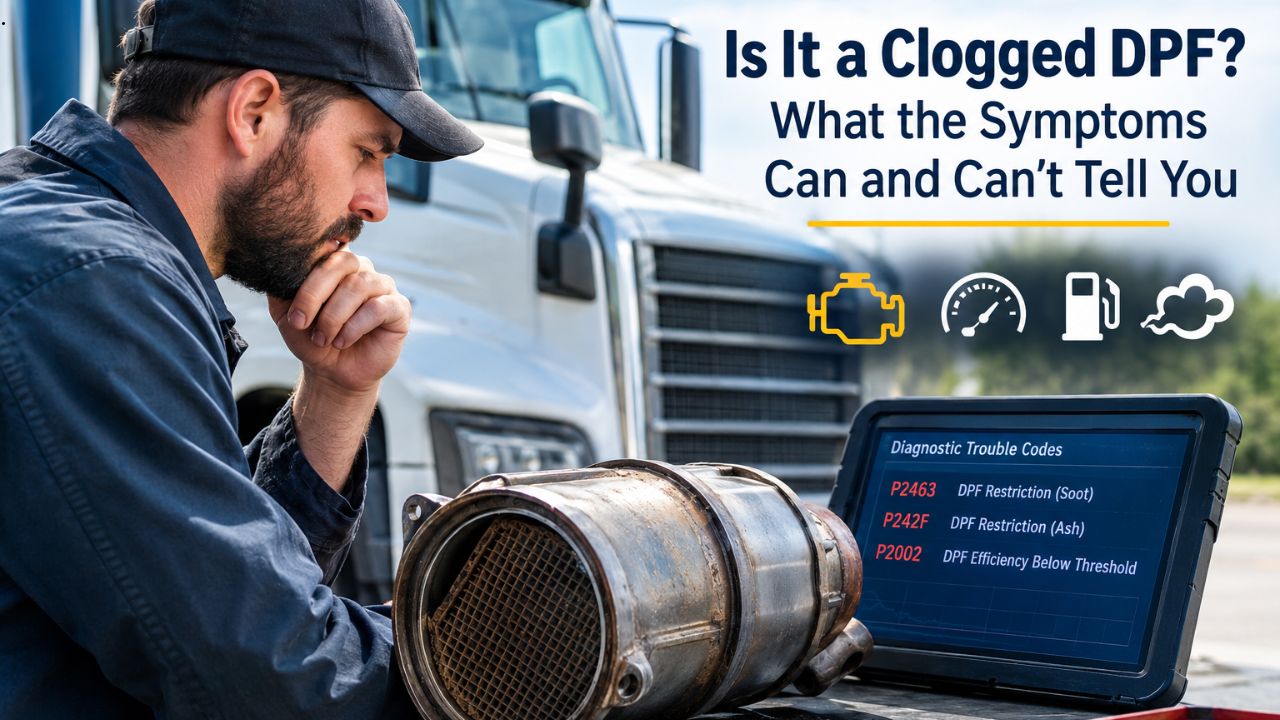
The truck feels flat pulling out of the yard, the dash is lit up with something exhaust-related, and by the end of the shift the diagnosis has already been made: it’s the filter. Sometimes that’s right. A clogged dpf filter is also the most popular explanation for a long list of symptoms, partly because it’s the one drivers have heard of. Before anyone orders a cleaning or a part, the symptoms deserve a harder look.
Table of Contents
Symptoms are circumstantial evidence
Take the common ones one at a time.
Power loss is the big one. A restricted filter can choke the exhaust, and many trucks also cut power on purpose as a protective strategy. But a boost leak, a fueling problem, a turbo issue, or a fault elsewhere in the emissions system can produce the same flat feeling, and some of those trigger the same reduced-power response.
Fuel economy is even less specific. Load, weather, tires, and the driver all move mileage. A DPF that’s regenerating more often burns extra fuel, so a drop may be a symptom of whatever is causing the frequent regens, not of the filter itself.
Smoke deserves more skepticism than it gets. A filter that’s doing its job traps soot, so visible black smoke doesn’t point cleanly at a clog. It can point the other way, toward a damaged or bypassed filter, or toward an engine making far more soot than the filter should be asked to handle.
The most telling pattern is regens that start and finish while the lamp returns soon after. That suggests the filter is filling again faster than it should. Soot output may be high, ash may have taken up capacity, or a sensor may be overstating restriction. Each of those leads to a different fix.
What the codes do and don’t say
Stored codes help, if you read them carefully. On many light-duty diesels, generic OBD-II codes give the first clue. P2463 is defined as diesel particulate filter restriction from soot accumulation, and P242F as restriction from ash accumulation rather than recoverable soot. That split matters. Soot can often be addressed through regeneration under the right conditions, while ash can’t be burned off.
P2002 gets misread more than the others. Its definition is DPF efficiency below threshold, which isn’t the same as restriction. References list causes ranging from soot loading and failed regens to a damaged substrate or bad sensor data. Read it as “clogged” and you may spend money on the wrong fix.
Code naming and procedures also vary by manufacturer, and heavy-duty engines often report faults in different formats. Treat any code as a pointer for further testing, not a verdict.
What else looks like a clog
A lot of what looks like a clogged filter is something else wearing its symptoms. Sensors are the usual suspects. A failing differential pressure sensor, or a cracked or plugged line, can report restriction that isn’t there. An exhaust leak ahead of the sensor can skew readings too.
A fouled EGR system pushes extra soot toward the filter, and its own symptoms, like a rough idle and a check-engine light, overlap with the filter’s. There’s a short rundown of DPF and EGR warning signs that shows how much those two overlap. Farther upstream, injector, boost, or air-system problems raise soot output, and an engine burning oil adds ash. None of those is fixed by cleaning the filter.
When to stop guessing, and when to stop driving
Some warnings aren’t for guessing at. If the truck displays a message telling you to stop driving, or power drops sharply, follow the owner’s manual rather than a forum thread. Procedures differ by vehicle. Some call for a sustained drive, some for a parked regen, and some for a shop visit.
What doesn’t help: clearing the code and carrying on, adding product after product, or running regen after regen when the first one failed. Repeating a forced regen on a filter that can’t complete one doesn’t fix the cause, and it puts the system through repeated high-temperature cycles. Two failed attempts is usually the point to stop and get a scan.
What a useful diagnosis looks like
Ask for evidence. A useful visit starts with a scan for stored and pending codes plus freeze-frame data, then a look at soot and ash load readings where the vehicle provides them, and a differential pressure check with the engine running. After that come the sensor, its lines, and the exhaust, checked for leaks. If the filter comes off, it should be inspected and flow-tested.
That last step is where a filter shop fits. 30 Minute DPF Clean, like any cleaning provider, can only assess the filter once it’s off the truck. Whatever sits upstream still needs a technician with a scan tool. The two aren’t competing. A good diagnosis tells you whether the filter should go to a shop at all.
Reasons to test, not conclusions
Reduced power, a lit lamp, worse mileage, and frequent regens are all fair reasons to suspect the filter. None of them is proof. Match the next step to what the data shows, and a clogged filter gets cleaned while a sensor fault, an EGR problem, or a cracked substrate gets what it actually needs.